A Day with a Mangrove Tiger: Tracking the Ghost of the Sundarbans
The “Sundarbans”! Just the name carries a sense of mystery and danger. Sprawling across West Bengal, India, and stretching into Bangladesh, this massive forest is six times the size of Greater London. It is a wild maze of muddy water channels, mudflats, and trees that grow right in the salty water. But what makes it truly special is its most famous resident: the Bengal tiger.
This is the only place on Earth where tigers live in a saltwater forest. It is also one of the few places left where humans are surely not at the top of the food chain. With nearly half a million people going into these forests to fish, catch crabs, and collect wild honey, conflicts between people and tigers happen every single day. It is easily one of the most dangerous places in the world.
What makes these tigers so interesting is how they have learned to live in such a harsh land. While scientists are still studying if they are different on the inside from terrestrial tigers, their behaviour is definitely unique. They drink salty water, swim incredibly fast, eat fish and crabs, and hunt in broad daylight. You can forget everything you know about normal tigers; these cats do things their own way.
Studying them is very hard. Radio collars break because the saltwater ruins the electronics, and the tough environment keeps the tigers stressed out. Plus, with a lot of people living nearby, food is scarce for both humans and tigers, meaning they often hunt the same things.
For days, my team and I had been trying to track a dominant male in a section of the park where visitors are allowed. In India, only 20% of a tiger reserve is open to the public, while the other 80% is strictly off-limits. This big male had a huge area that he shared with six or seven adult females. We spent days anticipating, tracking his footprints in the mud and looking for slides where he went into the water. We caught a few quick glimpses, but nothing more.
Then, on a foggy winter morning, our luck finally changed.
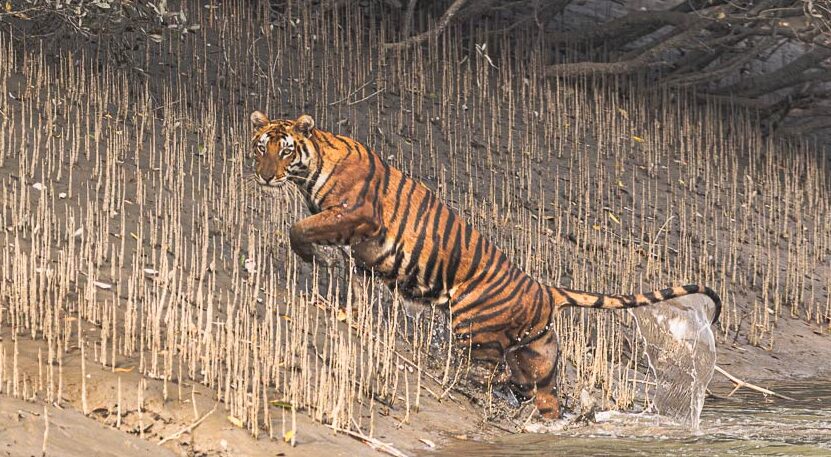
After three days of searching, we spotted him crossing a water channel. Through the thick fog, I used my longest camera lens to capture the exact moment he stepped into the water. Because we were in a boat, we could only stay in the wider rivers, so we kept our distance to make sure he felt safe and comfortable.
To our absolute surprise, he ended up staying near us for the next six hours.
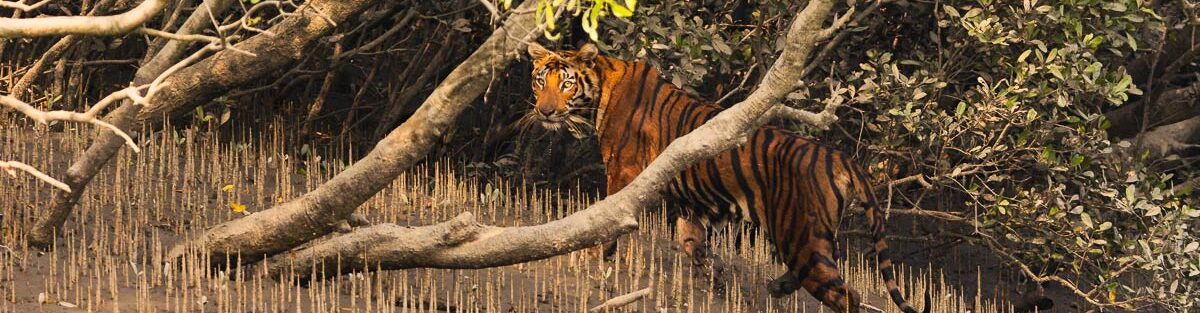
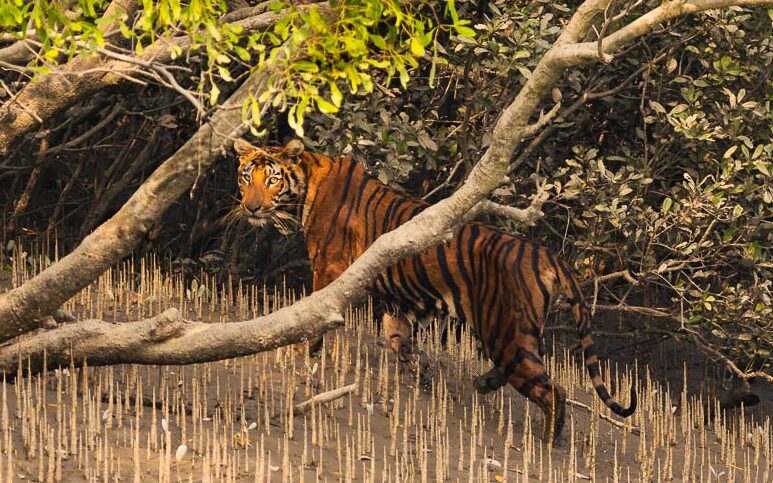
Watching him walk along the muddy banks was incredible. If you have ever seen a mangrove forest, you know the ground is full of sharp, hard roots that stick straight up out of the mud like spikes. We watched in wonder as he walked easily over these sharp roots, through thick grass, and across tangled tree roots. At times, his legs sank deep into the thick mud, but he still moved with total control and ease. He would casually hop over narrow ditches and stretch his long body to jump across the wider ones.
As we drifted along, we got to see his daily routine up close. He spent a lot of time walking his boundary, spraying the trees to mark his territory and show his dominance. This scent can last up to two months, announcing his presence and helping females find him as a mate. We caught him sniffing tree trunks to check if other tigers had been there, and digging up mud to cover his scat, typical to tigers.
Life here revolves around the tides, which rise and fall twice a day. When the tide goes out and the mud is showing, that is when the tigers prefer to swim across the big rivers. Over those six hours, this big male swam across one massive river and five large channels. Every now and then, he would disappear inside the thick mangroves for a quick rest, leaving us waiting nervously in our boat. After a while, he would come back out into the open and keep walking to look for food, fresh water, and a mate.
The ground is always muddy, the floor is covered in sharp spikes, the water is salty, and the air is hot and sticky. Yet, nothing stops the tough Sundarbans tiger from walking. Spending a day in his world was a great reminder of just how resilient nature can be.

That memory never faded. The forests kept calling, even as studies, work, and family filled my days.